Nagasaki Stadium City generates ¥37.8 billion annual economic impact for prefecture

Nagasaki Stadium City and its two professional sports clubs are estimated to generate an annual economic ripple effect of ¥37.83 billion for Nagasaki Prefecture, highlighting the economic importance of the mixed-use sports development. Almost half of the impact is expected to reach businesses and industries outside the complex, according to a study from Funai Soken.
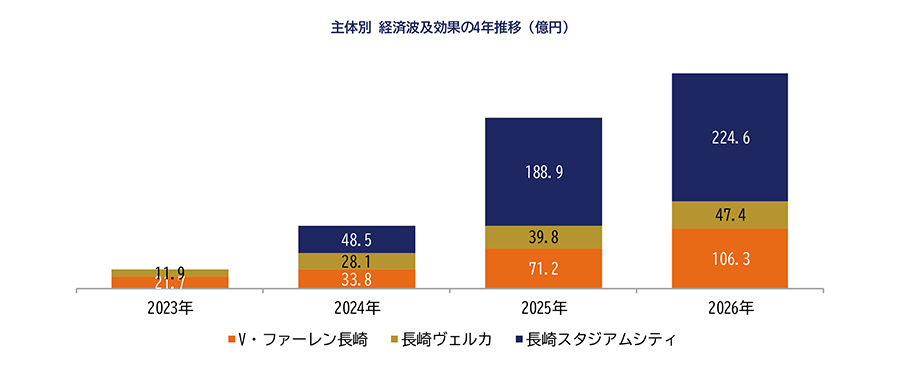
The economic impact assessment, commissioned by Japanet, evaluates the combined economic and social contribution of Nagasaki Stadium City, football club V-Varen Nagasaki and basketball club Nagasaki Velca. It estimates that their combined economic impact will reach ¥37.83 billion in 2026, approximately 11 times the ¥3.36 billion recorded in 2023, before the stadium complex opened.
Opened in October 2024, Nagasaki Stadium City is a privately developed, approximately 75,000-square-metre mixed-use complex in Nagasaki City. Led by Japanet, the development brings together the 20,000-seat Peace Stadium, home of V-Varen Nagasaki, the approximately 6,000-seat Happiness Arena, home of Nagasaki Velca, as well as a hotel, retail and commercial facilities, and offices.
The development attracted approximately 4.85 million visitors during its first year of operation, establishing itself as a major destination for sports, entertainment, shopping and hospitality.
Economic benefits extend beyond the complex
A notable finding of the Funai Soken assessment is the extent to which the economic benefits spread beyond the development itself. Of the estimated ¥37.83 billion ripple effect, approximately ¥17.8 billion, or 47%, is generated outside the complex but within Nagasaki Prefecture.
This includes around ¥4 billion in direct spending by visitors at hotels, restaurants, transport providers and other businesses across the prefecture, alongside a further ¥13.8 billion in indirect demand generated through supply chains and subsequent spending.
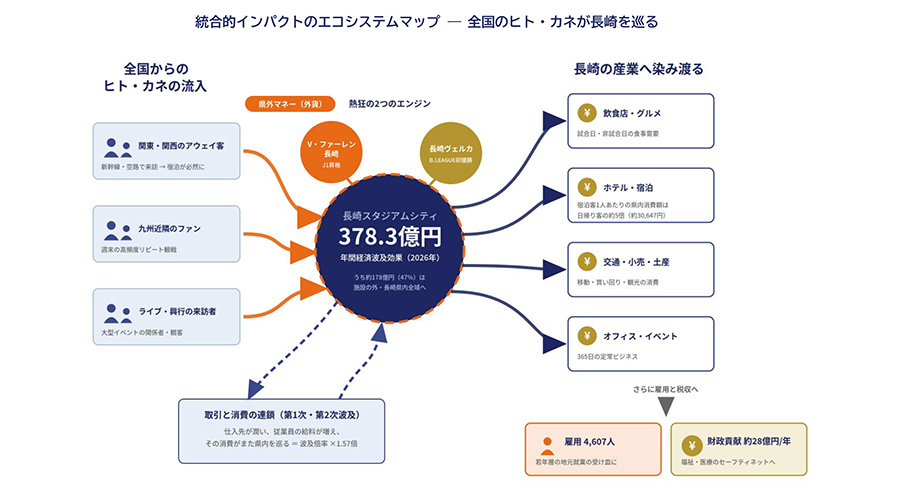
The findings illustrate according to the authors how a large-scale sports development can stimulate activity across a wider regional economy, rather than concentrating its financial benefits within the facility and its operators.
The three components contribute differently to the overall impact. Nagasaki Stadium City accounts for the largest share, at ¥22.46 billion, or 59% of the total. V-Varen Nagasaki contributes an estimated ¥10.63 billion (28%), while Nagasaki Velca accounts for ¥4.74 billion (13%).
A business model that works beyond match days
Another significant finding concerns the ability of the complex to generate economic activity throughout the year. Of the ¥29.09 billion in annual demand generated within the prefecture, approximately ¥16.22 billion, or 56%, is attributed to days without matches. This exceeds the ¥13.09 billion associated with match days.
The distinction is important for the economics of stadium developments, which traditionally depend heavily on relatively limited sporting calendars. In Nagasaki, hotels, offices, retail businesses and independently organised events provide a continuing source of activity, while the two professional clubs attract visitors and spending on match days.
Tourism-related spending also contributes to the wider impact. An estimated 48.1% of visiting supporters from outside the prefecture stay overnight, with average spending of ¥30,647 per overnight visitor – approximately five times the expenditure of day visitors. Spending by visiting football supporters alone is estimated at ¥1.67 billion annually.
Employment and public finances
Beyond its economic output, the development is expected to generate 4,607 jobs annually through direct and indirect economic activity. The estimate is comparable to Nagasaki Prefecture’s annual net population outflow of approximately 4,000 to 5,000 people, highlighting the potential contribution of the project to local employment opportunities, particularly for younger residents.
The assessment also estimates an annual fiscal contribution of approximately ¥2.8 billion, comprising around ¥1.8 billion in additional local tax revenue generated through economic activity and approximately ¥1 billion in property-related taxes paid by the facilities.
The figures suggest that the benefits of the development extend beyond sports and entertainment, potentially supporting local businesses, employment and public finances.