Southeast Asia’s growing LNG market makes case for its own price benchmark

Amid an energy landscape characterized by rising power demand, energy transition goals, and declining domestic output, Southeast Asia is emerging as one of the world’s fastest-growing LNG (liquefied natural gas) import regions.
Southeast Asia accounted for around a tenth of Asia’s LNG imports in 2025. Thailand imported the most, followed by Singapore and Malaysia. As the balance shifts in Asia, a new insight paper from Argus Media questions if LNG delivered to Southeast Asia should be priced against Northeast Asia market fundamentals.
Imports across Southeast Asia’s key markets grew by more than 20% between 2022 and 2024, reaching nearly 13 million metric tons. In the first half of 2026, imports hit a record 11.7 million metric tons, according to data from Global Trade Tracker, even though Middle East supplies have been curtailed since early March.
Thailand and Malaysia led the increase, although increases in demand are seasonal, rising in the hot months when air conditioning and refrigeration needs increase significantly. The Philippines has become one of the fastest-growing markets, with imports more than doubling in 2024 and rising by a further 42% in 2025. Argus said that, assuming 5% demand growth, the region will import an additional 278,000 metric tons in the second half of 2026 compared with a year earlier, led by Thailand, the Philippines, and Vietnam.
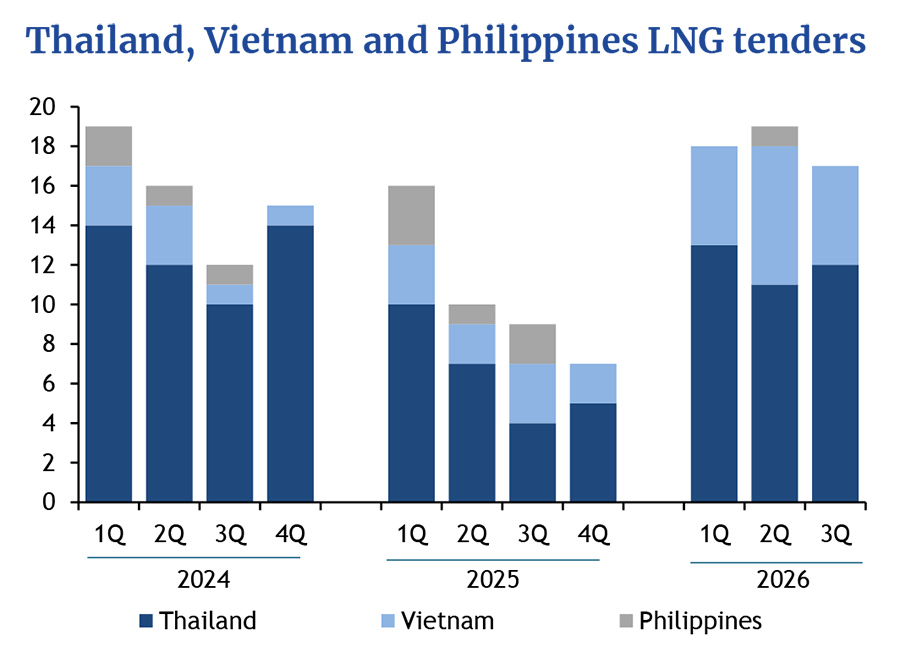
Buyers are also turning more often to the spot market, where cargoes are bought for near-term delivery rather than under long-term contracts. Argus recorded up to 40 spot tenders in the region as of Sept. 3, more than in all of 2024 and equal to the total for 2025. Activity picked up notably in the third quarter, especially from Thailand and Vietnam.
The firm interest from Thailand may have been driven by a cargo shortage after long-term supplies from Qatar’s Ras Laffan terminal, the world’s largest LNG export terminal, were not delivered due to extensive damage from Iranian attacks on the facility. Singapore, in contrast, secures most of its gas through term contracts rather than spot purchases.
Aging gas fields and new terminals
The report said demand is particularly strong in Thailand and Malaysia, where maturing gas fields are shrinking domestic supply. Imports of LNG are the most immediate and reliable way to fill that gap and protect energy security. In Thailand, falling domestic production could eventually lead to imports rising beyond 2026.
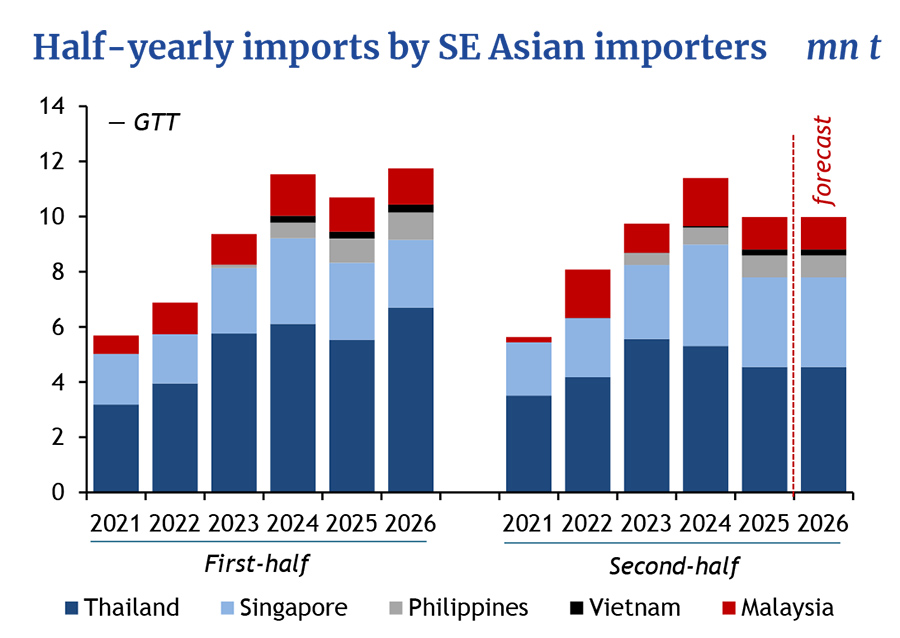
Malaysia is building up its import capacity to serve rising industrial demand, including from fast-growing data centers, while phasing out coal-fired power. The government has approved a third regasification terminal, which turns LNG back into gas, in Lumut in the southwestern state of Perak. If it is completed by 2029, the country’s import capacity could exceed 10 million metric tons a year, compared with its current capacity of 7.8 million metric tons.
Indonesia, long a significant LNG exporter, is under pressure from falling domestic production. It cut exports by as much as 20% in 2025 and redirected the gas to domestic users. Argus notes that recent gas discoveries could ease that pressure, but continued growth in domestic demand could eventually force Indonesia to also import LNG. The report sees even greater potential in the Philippines and Vietnam, where power demand is rising with industrialization and economic expansion.
A price benchmark of its own
Because the region is so varied, with different infrastructure limits, fuel mixes, and buying strategies, Argus argued that it should not be priced simply by looking to Northeast Asia, where demand in Japan and South Korea is more mature. The company’s Southeast Asia index, known as ASEA, has mostly traded at a discount to its Northeast Asia counterpart, ANEA, at least since early last year.
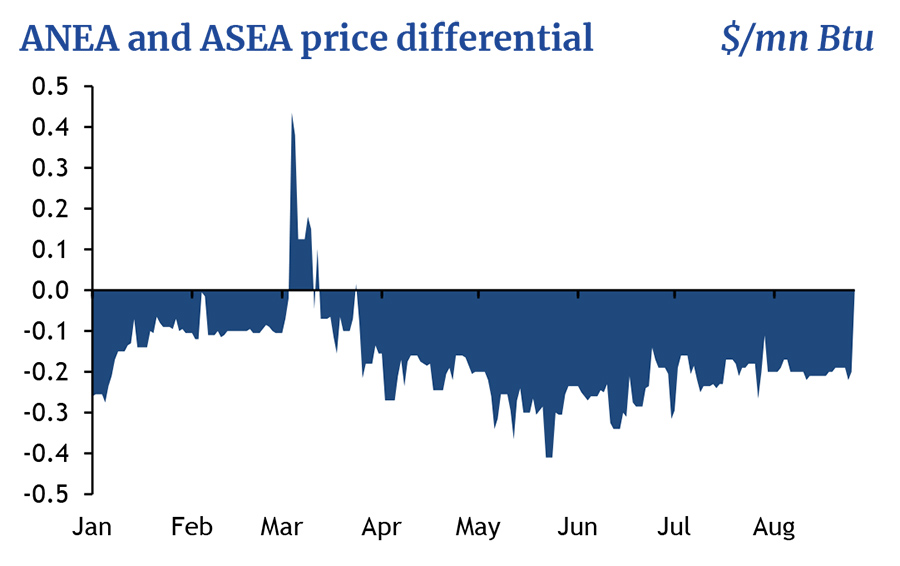
The report attributed this discount mainly to shorter shipping distances. Cargoes from major exporters such as Qatar and the United States, most of which travel around the Cape of Good Hope rather than through the Panama Canal, have less distance to cover to reach Southeast Asia, which lowers freight costs. Meanwhile, Australian cargoes can reach Vietnam in about a week.
The pattern reversed in early March, when ASEA hit a premium of almost $0.41 per million British Thermal Units (Btu), the highest since the index was launched. Argus said the swing followed the start of the U.S.-Iran war, which disrupted Middle East supply. Northeast Asian countries were able to lean more on nuclear and renewable power rather than pay higher prices, while Southeast Asia’s heavier reliance on LNG for electricity forced buyers to pay up.
The largest discount, $0.41 per million Btu, came on May 21, when Northeast Asian prices strengthened as offers pulled uncommitted cargoes away from Europe, while Southeast Asian demand stayed limited.
The Argus insight concluded that the need for a dedicated regional price reference will grow as Southeast Asia becomes a larger and more diverse market. It argues that ASEA was developed to reflect the region’s unique market dynamics and is well positioned to capture the growth and evolution of Southeast Asia’s LNG market as imports and spot activity continue to expand.