Asia faces $1 trillion annual investment challenge to meet energy security demands

Asia will need to invest as much as $1 trillion annually in its energy system over the next 15 years to meet rising demand, reduce dependence on imported fuels and strengthen resilience against supply disruptions. The scale of the challenge, outlined in a new report by McKinsey & Company, points to a fundamental shift in the region’s energy priorities.
The report from the global strategy consultancy, titled ‘Asia’s energy reckoning’, argues that the disruption to energy flows through the Strait of Hormuz in 2026 exposed vulnerabilities that have accumulated over decades. While the crisis brought energy security back to the top of the regional agenda, the analysis suggests that the underlying problem goes well beyond geopolitical instability.
Asia’s rapidly expanding economies are becoming increasingly reliant on imported energy, just as demand accelerates and domestic production from mature oil & gas fields declines. Addressing these pressures could require up to $15 trillion in cumulative investment through 2040.
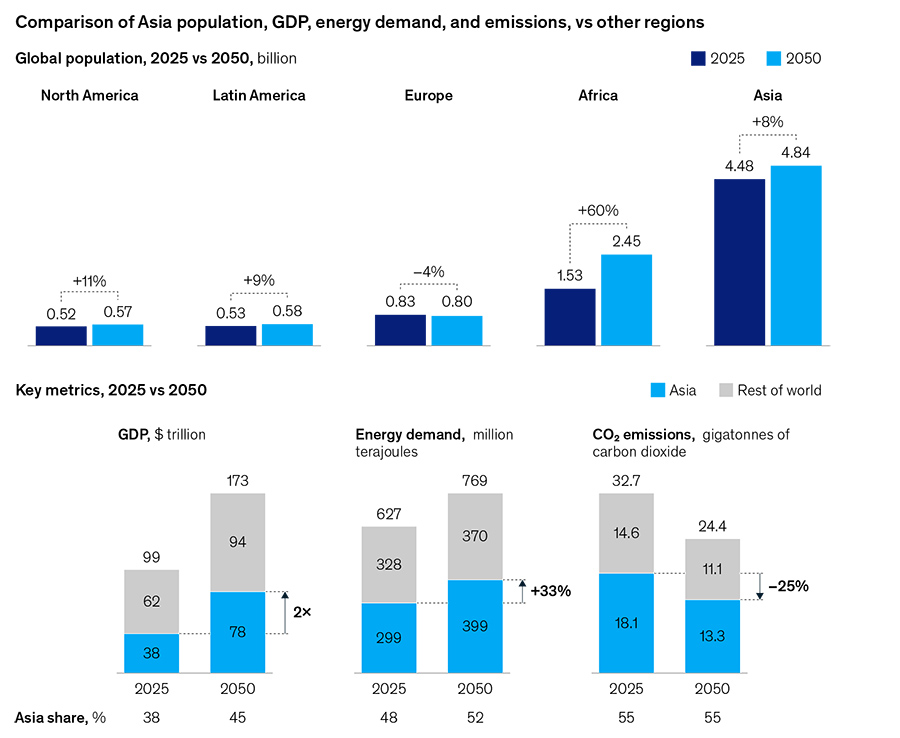
Asia will drive most of the world’s energy demand growth
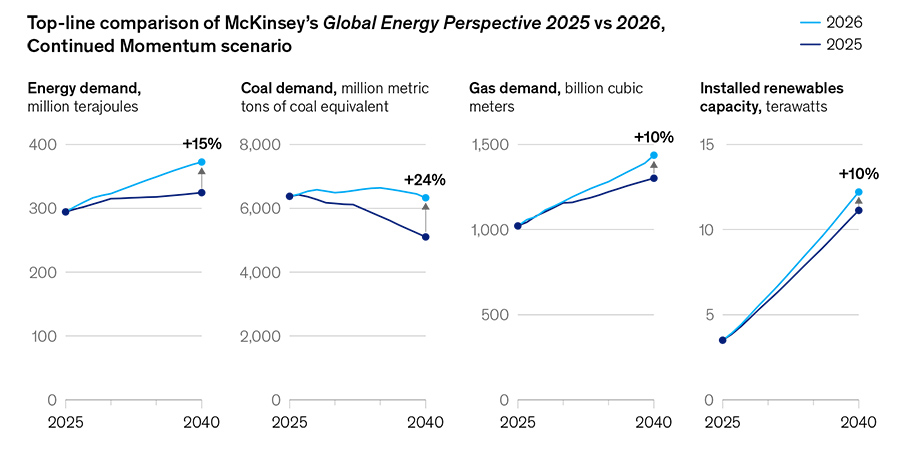
The scale of the challenge is driven by demand for energy. McKinsey forecasts that Asia’s energy demand will reach 370 million terajoules by 2040, 15% above its projection a year earlier. The region is expected to account for approximately 70% of global net energy demand growth over the period.
Industrial expansion, the proliferation of data centers and artificial intelligence infrastructure, and rising demand for cooling are among the main drivers. These trends are adding pressure to energy systems that are already struggling to keep pace with economic development.
Import dependence
Asia already accounts for nearly half of global energy demand, while producing only a fraction of the oil & gas it consumes. The region uses approximately 40 million barrels of crude oil per day but produces just 10 million barrels domestically. It also imported between 135 million and 140 million metric tons of liquefied natural gas (LNG) from outside the region in 2025.
The imbalance is expected to widen. Under McKinsey’s most likely scenario for the period ahead, domestic crude oil production could fall to around seven million barrels per day by 2040, while gas self-sufficiency declines from approximately 76% today to 60%.
The Strait of Hormuz disruption demonstrated the economic consequences of this exposure. Asia has historically sourced more than half of its crude oil imports and over 40% of its LNG imports through the strategic waterway. Supply interruptions contributed to fuel shortages in Pakistan, rolling blackouts in Bangladesh and higher fiscal costs for governments seeking to shield consumers from rising prices.
Diversifying suppliers and shipping routes is therefore important, says McKinsey & Company, although that does not eliminate the underlying risk: “Changing suppliers or routes, however, does not eliminate the underlying vulnerability created by import dependence.”
The Strait of Malacca, which carried more than 23 million barrels of crude oil per day in the first half of 2025, illustrates how reliance on alternative maritime chokepoints could simply shift the exposure.
No single energy strategy will work across Asia
The authors emphasize that Asian countries face different energy-security challenges depending on their domestic resources, economic position and reliance on imports.
Japan, Singapore and South Korea, for example, have established storage capacity and the financial resources to secure alternative supplies, while exploring domestic generation and other energy sources. China has greater flexibility through its strategic reserves, extensive domestic energy production and large renewable and nuclear capacity.
India faces a different balancing act, with rapidly rising demand requiring continued investment in domestic coal and renewables. Indonesia and Malaysia can draw on domestic resources and biofuel production, although subsidies and rising consumption put pressure on public finances. Bangladesh, Pakistan and the Philippines, meanwhile, have fewer domestic resources and face more difficult choices when supply disruptions occur.
According to McKinsey’s analysis, this diversity means that energy security cannot be addressed through a single regional blueprint. Countries will need to develop strategies that reflect their own resource endowments and vulnerabilities.
Investment must go beyond energy generation
The report identifies five priorities for building a more resilient energy system: increasing domestic production and local alternatives, diversifying imports, strengthening infrastructure, adapting energy systems to changing demand, and mobilizing capital while improving project execution.
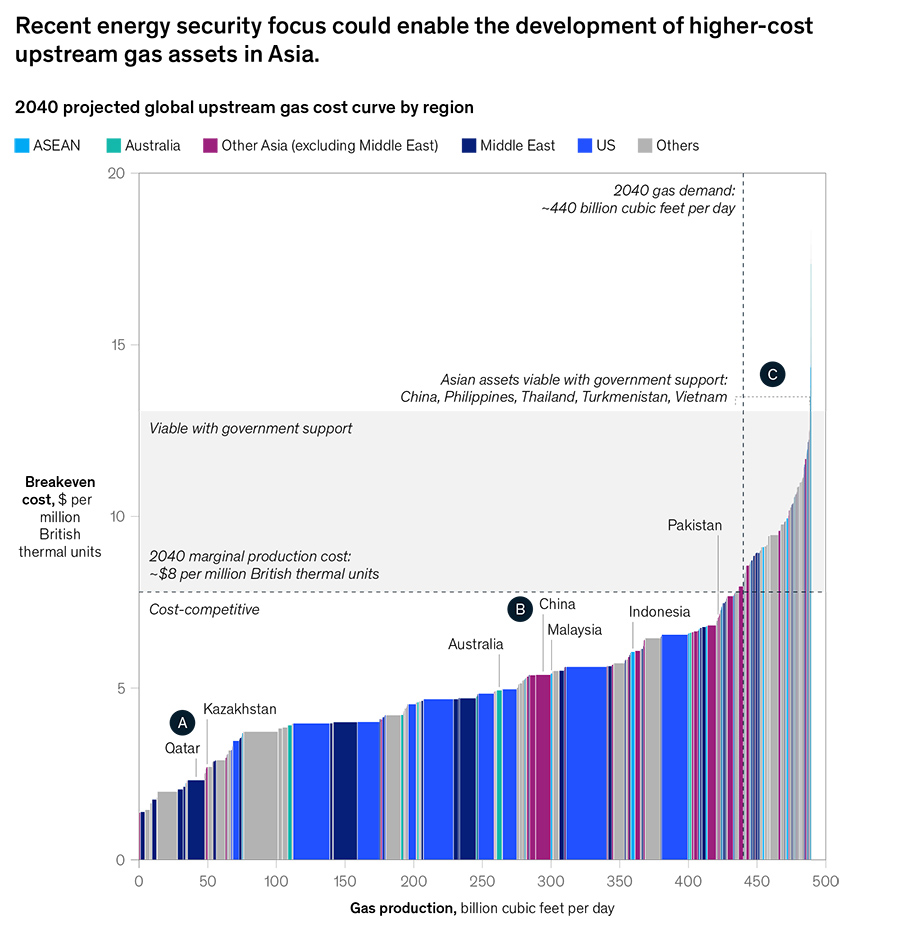
Domestic oil and gas production remains part of the equation. McKinsey estimates that more than $60 billion in annual investment could be required simply to maintain current Asian gas production levels as existing fields mature. Further investment could unlock an additional 10 billion to 15 billion cubic feet per day of domestic gas production, particularly across Southeast Asia, Central Asia and China.
At the same time, renewables represent the region’s largest energy investment opportunity, with annual solar and wind investment expected to reach approximately $300 billion through 2040. Biofuels could also replace $90 billion to $100 billion in fuel imports by 2040.
But generation capacity alone will not deliver energy security. Grid investment will need to rise from approximately $185 billion annually today to more than $300 billion by 2030. Storage, transmission networks and cross-border connections will be essential to ensure that electricity can reach consumers reliably.
The rapid expansion of AI infrastructure makes the timing particularly important. The authors note that data centers can be built in one to three years, while major grid upgrades can take five years or longer. Malaysia, for example, has already received more than 12 gigawatts of data center power applications, equivalent to around 40% of its installed generation capacity.
Key takeaways
For Asia’s energy sector, McKinsey’s report highlights how the next 15 years will be of major importance for meeting energy demand and ensuring energy security. Investments across renewables, conventional energy, grid infrastructure, storage, biofuels and energy logistics will all be key building blocks of the journey ahead.
Additionally, governments and private-sector stakeholders will need to coordinate more closely to make projects commercially viable and accelerate delivery.
Meanwhile, Asia’s energy system must not only grow and evolve, but also become more resilient. “The decisions made now will help determine whether the region can sustain its economic expansion without leaving itself increasingly exposed to the next energy shock,” the authors concluded.