Indian and South Korean travellers to reshape Asia-Pacific travel retail market

Indian and South Korean travellers are set to reshape Asia-Pacific’s travel retail market, reducing the sector’s traditional reliance on Chinese consumers. As the traveller base becomes more diverse and shopping preferences evolve, airport retailers and brands will need to adapt their offerings to appeal to these emerging customer groups.
That is the central conclusion of a new report by global management consultancy Oliver Wyman, produced in partnership with the Tax Free World Association (TFWA). The study identifies a structural shift in the region’s travel retail market, with Chinese travellers continuing to play an important role, while India and South Korea emerge as increasingly significant sources of future growth.
While Chinese consumers historically accounted for around 65% of Asia-Pacific travel retail growth, Oliver Wyman and TFWA expect their contribution to decline to approximately 40% over the next decade.
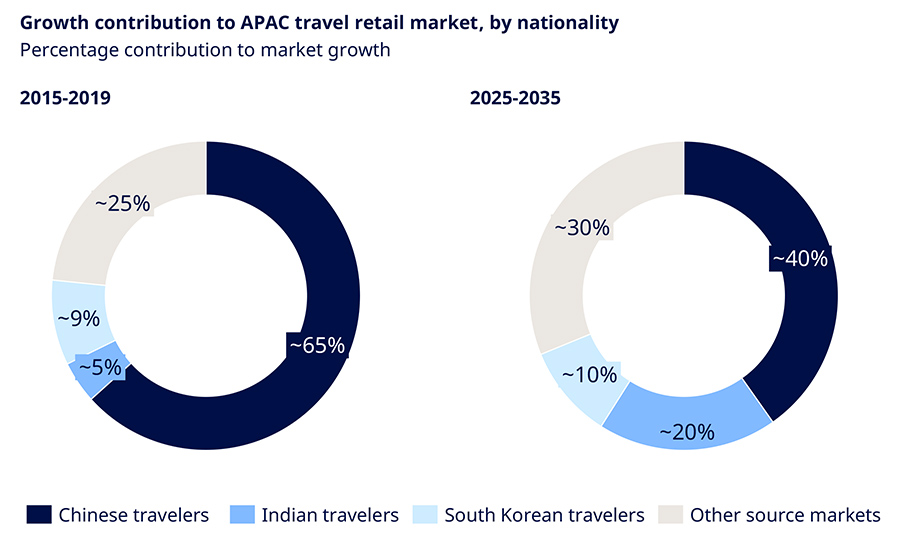
Indian and South Korean travellers, meanwhile, are projected to account for 20% and 10% of future growth, respectively, bringing distinct spending habits, product preferences and service expectations.
Indian spending on travel retail in Asia-Pacific is projected to quadruple between 2025 and 2035, driven by a rapidly expanding affluent consumer base and younger travellers with strong appetite for international travel. Unlike Chinese shoppers, Indian consumers tend to do much of their duty-free shopping on arrival rather than departure. They also show particular interest in categories such as wine and spirits, gold, confectionery and fine food.
South Korean travellers, by contrast, have a strong preference for beauty and fashion. To capture spending from both groups, airport retailers will need to rethink their product assortments, store formats and customer engagement strategies.
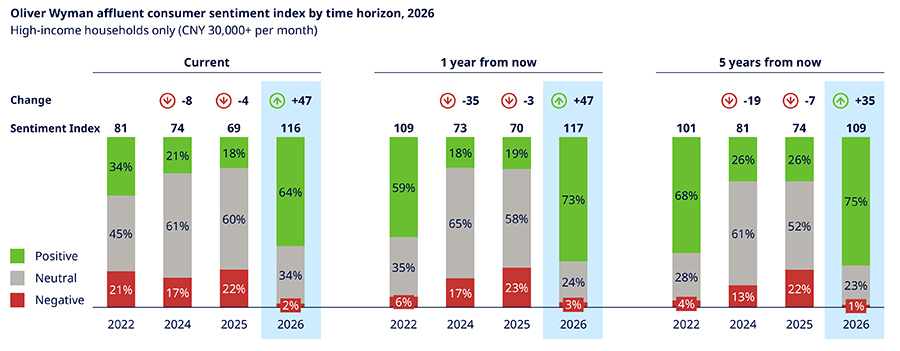
Meanwhile, China is showing renewed momentum as a source of travel retail spending. After several subdued years, affluent Chinese consumers are travelling more and increasing their spending on personal luxury goods. The recovery is uneven, however. Older generations are driving much of the rebound, while younger consumers remain more selective, favouring prestige beauty and luxury apparel over watches and leather goods.
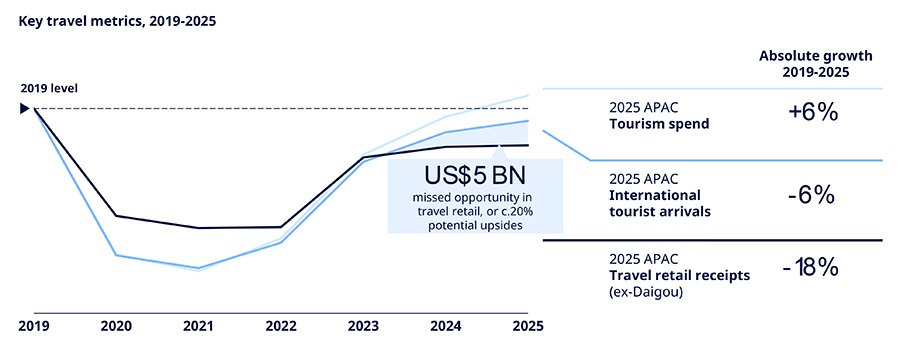
The broader opportunity extends beyond attracting more travellers. According to the study, Asia-Pacific travel retail has captured only 71% of footfall growth and 67% of tourism spending growth since borders reopened, leaving an estimated $5 billion in untapped value.
Two factors are holding back performance: a growing share of luxury spending taking place in domestic markets, and airport retail propositions that are not compelling enough to convert passenger traffic into sales.
The report argues that retailers and brands must move beyond competing primarily on price. Success will depend on “creating value that transcends traditional promotional levers”. This means developing exclusive, locally relevant product offerings, engaging travellers throughout their journeys and strengthening collaboration between brands, retailers and airports through data sharing.
Technology will also become an increasingly important differentiator. While 76% of surveyed executives consider innovation critical to sustaining growth, only 40% rank it as a top investment priority. Customer-facing AI applications remain at an early stage, with just 7% of executives having deployed solutions in areas such as personalisation, customer relationship management and targeted offers.
Oliver Wyman and TFWA conclude that the retailers and brands best positioned to capture the next phase of growth will be those that combine a deeper understanding of diverse traveller groups with more agile, data-driven operating models.