CEOs in Asia-Pacific feel better prepared than global peers for mounting disruption

CEOs across Asia-Pacific are bracing for greater geopolitical disruption and economic uncertainty, yet their confidence in their ability to adapt has reached a three-year high, according to a new study by Egon Zehnder. The findings highlight how business leaders are actively reshaping their organisations to navigate an increasingly unpredictable environment.
Titled ‘The CEO Response’, the Egon Zehnder study is based on the view of 843 CEOs from around the world, including 70 leaders based in the Asia-Pacific (APAC) region.
The findings show that CEOs in the region differ from their global peers in a number of areas, including preparedness for disruption.
CEOs in APAC expect more geopolitical disruption over the coming year than CEOs elsewhere, at 73% versus 62% globally, and 85% rate economic uncertainty as critical or existentially critical.
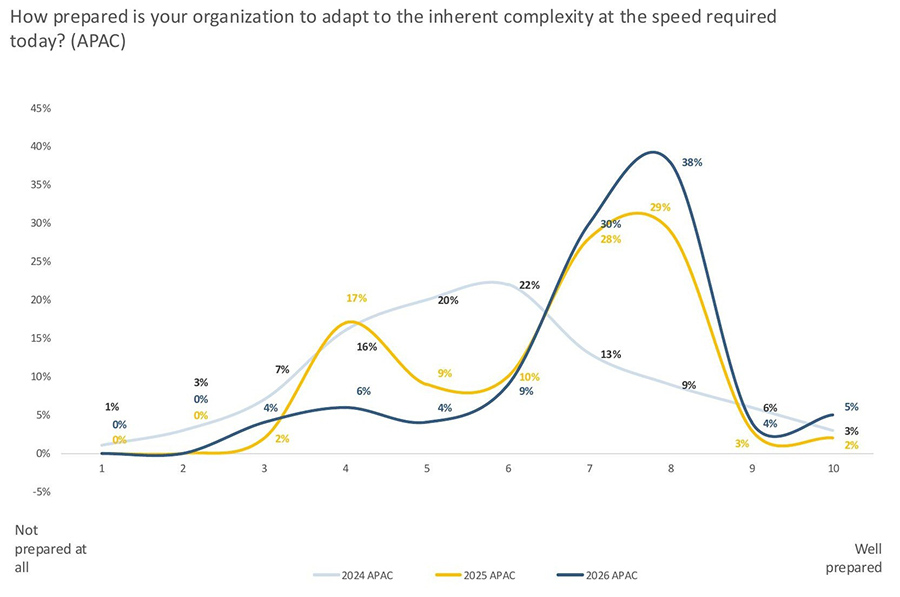
At the same time, APAC-based CEOs report their highest level of preparedness in the past three years, while in comparison, confidence in the rest of the world has begun to ease. The proportion of APAC chief executives rating their organisation’s readiness to adapt at the speed required at 7 or above (on a 10-point scale) has risen from 31% in 2024 to 62% in 2025 and 78% this year. Close to half, 47%, now rate themselves at 8 or above, compared with 26% globally.
In contrast, the global measure for of preparedness eased from 64% in 2025 to 58% in 2026.
“Expecting more disruption and feeling ready for it are not contradictory here,” said Ang Wan May, Managing Partner of Egon Zehnder’s business in Singapore. “Leaders in this region have spent the past three years working through supply chain shocks, conflict and a shifting trade map, and have continued to grow through it. The data likely reflects leaders’ mental preparedness for further disruption and the greater responsiveness of both leaders and organisations.”
AI sits at the top of the agenda of CEOs
AI is now the challenge chief executives consider most critical to their organisations, worldwide and in Asia-Pacific alike, having edged ahead of geopolitical instability globally and economic uncertainty in the region. The consensus in the region is close to universal, with only 6% rating it less critical, the smallest proportion recorded for any challenge.
“CEOs can invest in AI much faster than they can change how an organization works,” said Francesco Buquicchio, CEO of Egon Zehnder. “That gap matters. Leaders need to be clear about where the technology will make a difference, who has the skills to put it to use and what they must keep investing in for the long term.”
Wan May added: “The organisations creating the Chief AI roles in Singapore are the data-driven ones, the companies already furthest along. Where boards once asked for a technology leader to deliver a platform, they now want someone who will lead the AI strategy and deployment across the business. We would expect these roles to evolve as AI becomes embedded, much as the digital transformation roles of a decade ago were eventually absorbed into the business.”
Changes to business model and organsiation
Asked what major changes they are making, APAC leaders cite innovation most often, with AI investment close behind, while globally AI investment comes first. They also rank new strategic alliances and partnerships third, at 37% against 30% globally. The ordering reflects emphasis rather than choice, suggesting a region that frames AI within a broader innovation agenda rather than as a separate programme to be funded on its own.
They also lean much more heavily on relationships. Informal CEO networks are named among the most important alliances by close to three in four leaders in the region, against fewer than half globally. Public-private partnerships are valued more highly here as well, at 41% vs. 32% globally, and more than half say business alliances have grown more important over the past year.